Treadmills
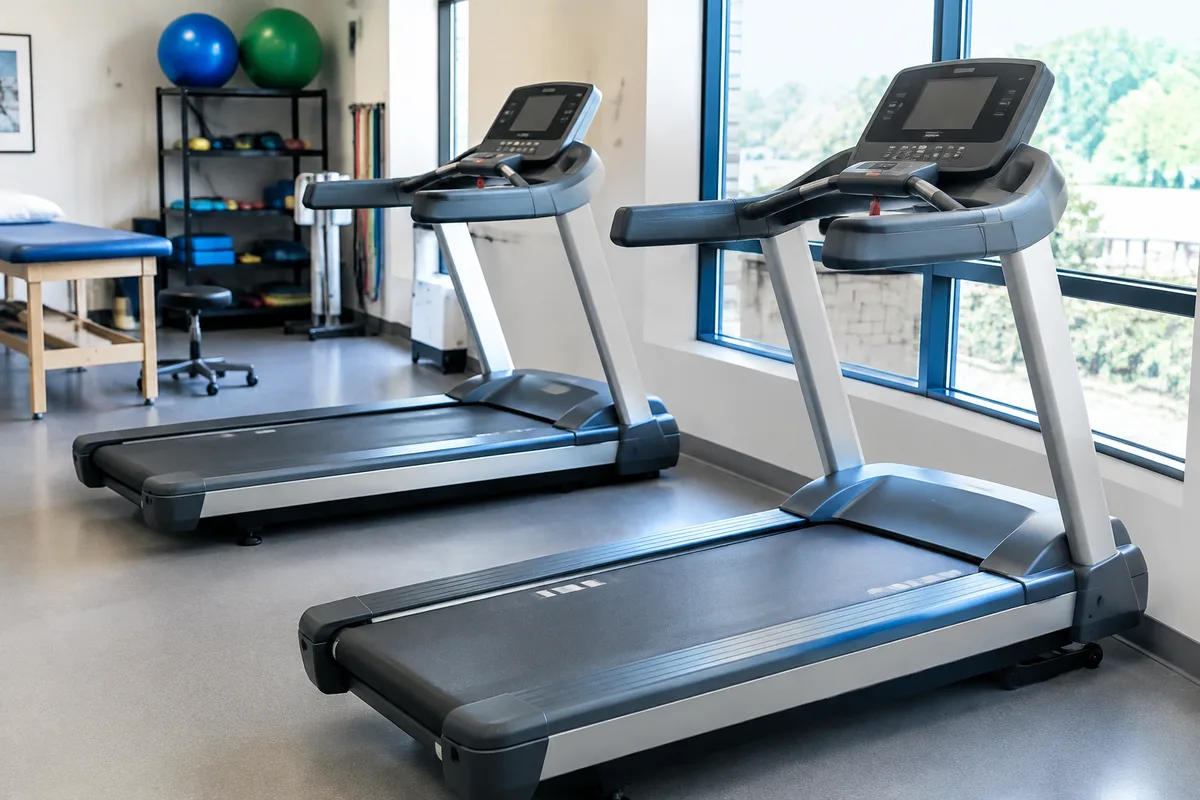
Treadmills
Walking is one of the simplest measures of recovery, and one of the most important. Treadmills at Physical Therapy and Rehabilitation Center of Brooklyn provide a controlled, supervised way to rebuild gait, endurance and cardiovascular fitness after injury, surgery, or a period of reduced activity.
What treadmills is
A treadmill is a motorized moving belt that lets a person walk or jog in place while a clinician observes speed, incline, stride, and balance. Unlike walking outdoors or in a hallway, a treadmill allows precise control over pace and grade, and it lets a therapist stand close by to watch how the body moves step by step.
For rehabilitation purposes, treadmills replaced the older approach of relying solely on open-floor walking practice, where speed and terrain were hard to standardize and observe consistently. With a treadmill, the same walking task can be repeated at a known pace, adjusted gradually as strength and confidence improve, and monitored closely for signs of fatigue, limping, or unsteadiness.
How we use it at Physical Therapy and Rehabilitation Center of Brooklyn
At our practice, treadmills are used for supervised walking and conditioning as part of a broader plan to restore gait and cardiovascular fitness. This fits naturally alongside services such as Walking Rehabilitation, Balance Training, Fall Prevention, and Sports Injury Rehabilitation, where regaining a safe, efficient walking pattern is often a central goal.
Treadmill sessions are typically paired with other on-site equipment as needed. For example, a patient working on balance may also use Balance Pads or Balance Boards on the same visit, while someone recovering from a lower-body injury might combine treadmill walking with Stationary Bikes for varied low-impact conditioning. Heat Packs or Cold Packs may be used before or after a walking session depending on how the joints and muscles are responding.
Because gait training is closely tied to how the whole body moves, treadmill use is generally guided by a clinician who watches your steps, checks your posture, and adjusts speed or incline based on what they observe during the session.
What it means for you
Supervised treadmill walking offers a few practical advantages over walking practice alone. Because the pace is controlled, it is easier to work at a level that challenges you without overwhelming you. Because a clinician is present, small issues with balance or gait pattern can be noticed and addressed early, rather than becoming habits that are harder to correct later.
- Comfort — incline and speed can be adjusted gradually, so sessions can start gently and progress at a pace that suits your recovery.
- Safety — walking under supervision means someone is watching for signs of unsteadiness, fatigue, or pain.
- Clear feedback — your therapist can point out specific aspects of your gait, such as stride length or foot placement, in real time.
- Consistency — because the walking surface and pace are controlled, progress from one session to the next is easier to compare.
What to expect during your visit
Before stepping onto the treadmill, your therapist will typically check in about how you are feeling that day, review any recent changes in pain or mobility, and may apply a Heat Pack or have you do some light stretching to prepare your muscles and joints. Footwear and any assistive devices are checked for safety.
During the walking session itself, your therapist will set an initial speed and, if appropriate, an incline, then observe your gait closely. You may be asked to focus on specific cues, such as taking even steps or standing taller. Sessions are generally kept short at first and lengthened gradually as tolerance improves. A handrail is available for support if needed, and the pace can be slowed or stopped immediately if you feel unsteady or fatigued.
Afterward, your therapist may apply a Cold Pack if there is swelling or soreness, and will often note how the session went to help plan the next one. Many patients feel a mild, expected tiredness in the legs after a session, similar to any moderate walking exercise.
Frequently asked questions
Is treadmill walking safe after an injury or surgery?
Treadmill sessions are supervised, so speed and incline are set to a level appropriate for your current condition and adjusted as you progress. Your therapist watches closely throughout the session and can slow or stop the treadmill at any time if you feel unsteady or uncomfortable.
How long does a treadmill session usually take?
The length of a session depends on your individual plan and how you are tolerating the activity that day. Sessions are often kept brief when starting out and may be extended gradually as endurance and confidence build.
Will using a treadmill hurt?
Some mild fatigue or muscle soreness afterward is common, similar to any walking exercise, but the pace and incline are chosen to keep the activity manageable. Let your therapist know right away if you feel sharp pain or significant discomfort during a session.
Who is treadmill training suitable for?
Treadmill walking can be part of a plan for a wide range of patients, including those recovering from surgery, working on balance, rebuilding cardiovascular fitness, or regaining a steady gait after injury. Whether it is appropriate for you depends on your specific condition and current abilities, which your therapist will assess.
If you would like to learn more about how supervised treadmill walking could fit into your recovery, reach out to Physical Therapy and Rehabilitation Center of Brooklyn to ask about scheduling a visit.
This content is for general information only and isn't medical advice. Talk with a qualified provider about your own situation. If you have a medical emergency, call 911.