Shockwave Therapy Machines
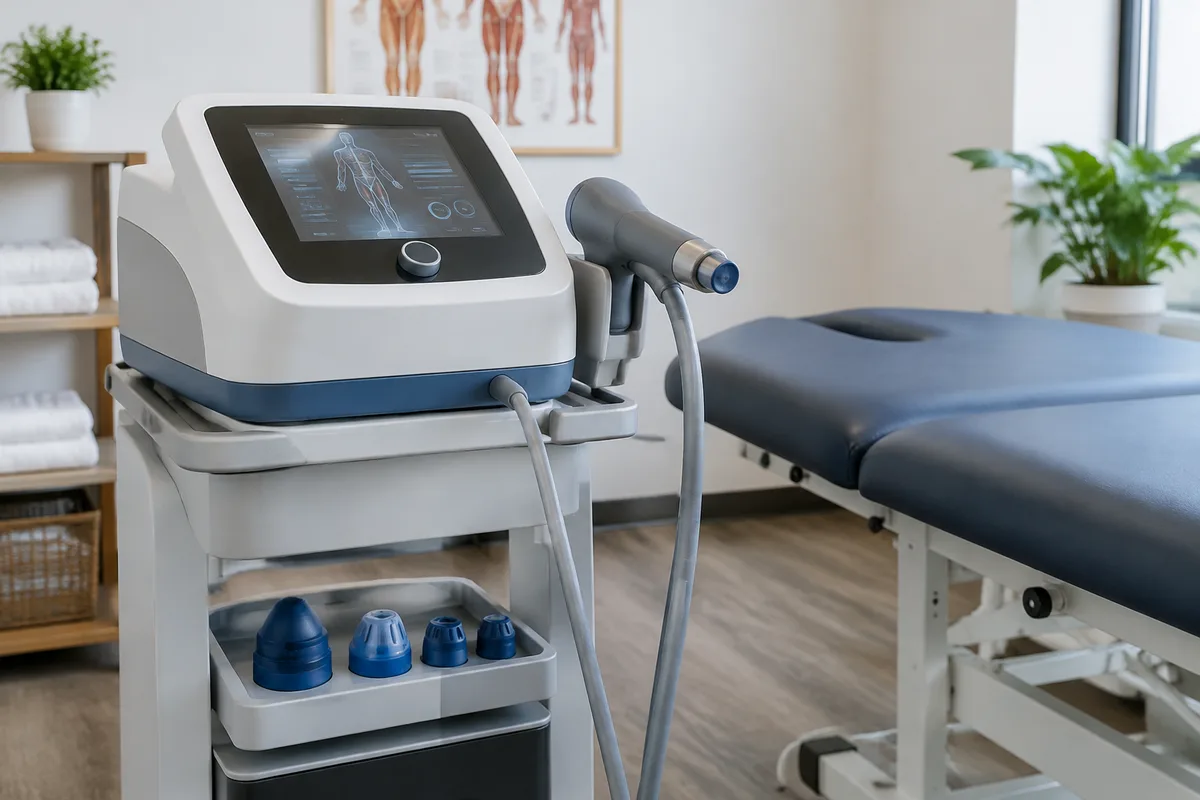
Shockwave Therapy Machines
Shockwave therapy uses focused acoustic waves to stimulate healing in tendons and soft tissue that have not responded well to rest or standard exercise programs. At Physical Therapy and Rehabilitation Center of Brooklyn, shockwave therapy machines are one of the tools available for stubborn, longstanding pain that has settled into a tendon or connective tissue and is slow to resolve on its own.
What shockwave Therapy Machines is
Shockwave therapy delivers a series of acoustic pulses through the skin to a targeted area of tissue. These pulses create a controlled mechanical stress in the tendon or soft tissue, which is thought to encourage local blood flow and prompt the body's own repair processes in tissue that has become stuck in a cycle of irritation and incomplete healing.
The approach is used for conditions where tissue has thickened, scarred, or simply stopped healing on its own timeline — often after months of symptoms rather than a fresh injury. It is a non-surgical option, applied through the skin without incisions, and is typically considered when more conservative measures such as stretching, strengthening, or rest have not fully resolved the problem.
Compared with relying on medication or waiting out an injury indefinitely, shockwave therapy gives clinicians a way to directly target a stubborn area of tissue as part of a broader rehabilitation plan.
How we use it at Physical Therapy and Rehabilitation Center of Brooklyn
Shockwave therapy machines at this practice are used specifically for stubborn tendon and soft-tissue pain — the kind that lingers despite other care. It is typically applied as one part of a larger treatment plan rather than a stand-alone fix, working alongside services such as manual therapy, exercise therapy, and tendonitis treatment.
Because recovering tissue often benefits from a mix of approaches, shockwave sessions may be paired with other on-site tools depending on what the tissue needs on a given visit. For example:
- Cold Laser Therapy — another non-invasive option sometimes used to address inflammation and support healing in the same treatment plan.
- Ultrasound Machines — therapeutic ultrasound that warms deep tissue, which may be used on separate visits to ease pain and support the same healing goals.
- Resistance Bands and Exercise Therapy — used to rebuild strength in and around the treated tendon once irritation begins to settle.
Your plan is built around the specific tendon or soft-tissue area involved and how it responds over the course of care.
What it means for you
For patients dealing with a tendon problem that has not improved with rest alone, shockwave therapy offers a non-surgical option that can be built directly into a broader rehabilitation plan. Because it is delivered through the skin, there is no incision and no anesthesia required, which generally means less disruption to your daily routine.
Treating the affected tissue directly can also make it easier to have a clear conversation with your therapist about what is happening in that specific area and how it is responding, session to session. This can be especially helpful when a tendon problem has dragged on and previous approaches have plateaued.
Because shockwave therapy is typically combined with exercise and manual therapy rather than replacing them, it fits into a plan that also focuses on longer-term strength and movement, not just symptom relief in the moment.
What to expect during your visit
A shockwave therapy session usually begins with your therapist identifying the specific area of tenderness, often by touch, before applying a gel to help the device make contact with the skin. The handheld applicator is then moved over the treatment area while it delivers a series of acoustic pulses.
Sessions are generally brief, often lasting only several minutes for the affected area itself, though your overall visit may include other therapy as well. Many patients feel a tapping or pulsing sensation during treatment, and some mild soreness at the site afterward is common, similar to how a muscle might feel after a workout.
After treatment, your therapist may guide you through gentle movement or stretching, and will typically advise on activity levels for the following day or two. Shockwave therapy is usually delivered as a short series of visits spaced apart, rather than a single session, to give tissue time to respond between treatments.
Frequently asked questions
Is shockwave therapy safe?
Shockwave therapy is a non-invasive, non-surgical treatment that is generally well tolerated. Your therapist will review your specific situation before beginning treatment to confirm it is an appropriate option for the tissue involved.
Does shockwave therapy hurt?
Most patients feel a tapping or pulsing sensation during the session, and the intensity can typically be adjusted based on your comfort. Mild soreness in the treated area afterward is common and usually settles within a day or two.
How many sessions will I need?
Shockwave therapy is usually delivered over a short series of visits rather than a single treatment, since tissue needs time to respond between sessions. Your therapist will outline a schedule based on the area being treated and how it progresses.
Who is shockwave therapy appropriate for?
Shockwave therapy is generally considered for tendon and soft-tissue pain that has persisted despite rest or other conservative care. It is not suitable for every condition, so your therapist will assess your history and the affected area before recommending it as part of your plan.
If stubborn tendon or soft-tissue pain has been slowing you down, reach out to Physical Therapy and Rehabilitation Center of Brooklyn to ask whether shockwave therapy is a good fit for your care plan.
This content is for general information only and isn't medical advice. Talk with a qualified provider about your own situation. If you have a medical emergency, call 911.