Sciatica, Explained: Why Leg Pain Can Start in Your Back
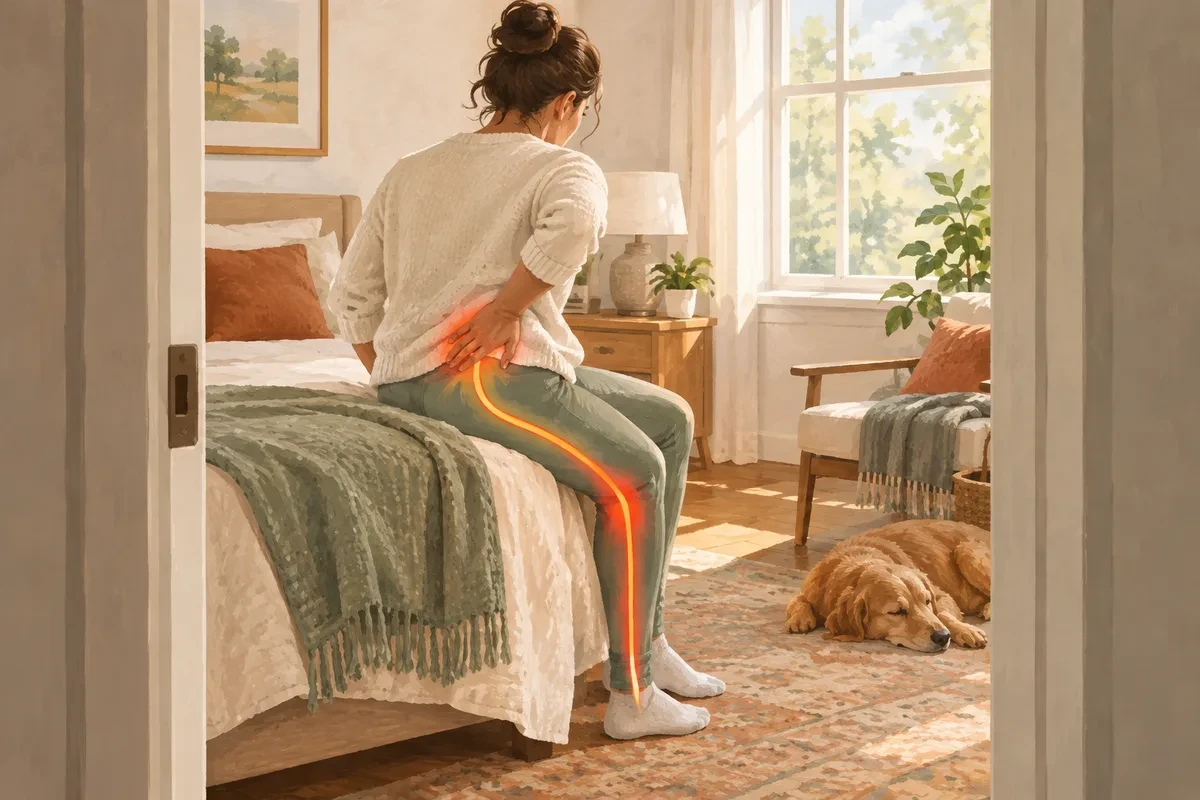
You feel it in your calf, or maybe your thigh, or shooting down toward your foot. Naturally, you assume the problem lives right there where it hurts. But with sciatica, the sore spot and the actual source of trouble are often two very different places.
This mismatch confuses a lot of people, and it's easy to see why. If your knee hurts, you probably strained your knee. If your leg is aching, though, the real story might be happening several feet away, in your lower back. Understanding how this works can help you make sense of your symptoms and take the right next steps.
What Sciatica Actually Is
Sciatica isn't a disease on its own. It's a description of what happens when the sciatic nerve, which runs from your lower back through your hip and down each leg, gets irritated or compressed somewhere along its path. That irritation often starts near the spine, where nerve roots exit between the vertebrae.
Because this nerve is so long, a problem at its starting point can send signals all the way down to your foot. The brain reads those signals as pain, tingling, numbness, or weakness in the leg, even though the actual irritation is happening up near the spine.
Why Pain Can Travel Far From Its Source
This idea is called referred pain, and it's more common than most people realize. Nerves act like long wires carrying messages between your body and your brain. When a wire gets pinched or pressed near one end, the disruption can be felt anywhere along its length, not just at the exact point of pressure.
Think of it like static on a phone line. The interference might be happening near the source, but you notice the crackling sound all the way at the other end, where you're listening. Your leg is the listening end. Your lower back, hip, or the space where nerve roots exit your spine is often where the actual interference begins.
This is also why treating only the painful leg often misses the point. If the irritation is coming from the spine, focusing solely on the calf or thigh may bring short-term relief without addressing what's actually causing the signal disruption in the first place.
Signs the Trouble May Be Coming From Your Back
A few patterns can hint that leg pain has a spinal origin. Pain that runs along a clear path, from the lower back or buttock down the back of the leg, tends to follow the route of the sciatic nerve itself. Numbness, tingling, or a burning sensation alongside the pain can also point toward nerve involvement rather than a simple muscle strain.
Symptoms that get worse with sitting, bending, or certain movements, and ease up with rest or repositioning, are another clue. Muscle strains usually respond differently to movement than nerve-related pain does.
None of this replaces a real evaluation, though. Many conditions can cause leg discomfort, and sorting out the actual cause takes a trained eye, some questions about your history, and often a physical exam.
How This Understanding Shapes Treatment
Once the source of the irritation is identified, care can be aimed at the right target instead of just the symptom. Depending on what's found, that might involve manual therapy to improve movement in the spine, chiropractic care to address alignment and joint mechanics, or a physical therapy plan built around strengthening and mobility.
Some patients benefit from spinal decompression techniques, which are designed to relieve pressure on nerve roots. Others do well with a broader nerve pain rehabilitation approach that combines several methods over time. The right combination really does depend on the individual, which is why a personal evaluation matters more than guesswork based on symptoms alone.
If your leg has been bothering you and you suspect your back might be the real culprit, it's worth having a professional take a closer look. Our team at Physical Therapy and Rehabilitation Center of Brooklyn works with patients throughout Brooklyn, NY to sort out where pain is really coming from and build a plan around that answer, not just the spot where it happens to hurt.
Questions about your specific symptoms are always worth asking directly rather than trying to figure out from general information alone. Give us a call, and we can talk through what you're experiencing and what next steps might look like for you.
Questions about your own care? The team at Spine and Orthopedic Rehabilitation Center is happy to help — call us at 929-909-5456 or request an appointment.
This content is for general information only and isn't medical advice. Talk with a qualified provider about your own situation. If you have a medical emergency, call 911.